On This Date In History
One Rule That Was Apparently Broken At The Little Bighorn
April 2, 2026
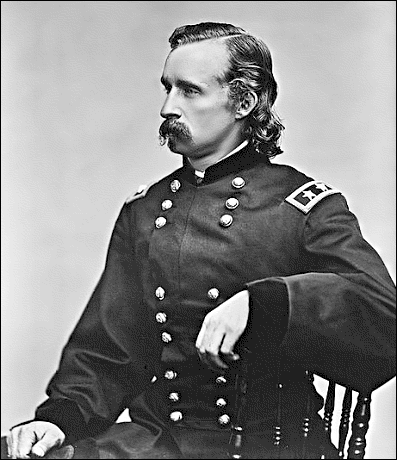
The Battle of the Little Bighorn is an event that has been shrouded in mystery for some time. Since the battle, people have wondered how the event could have unfolded the way it did. Some may still wonder about that today. In order to understand why the battle turned out the way it did, it may be helpful to examine a rule that was to govern U.S. forces when engaged with Native American warriors.
During the time when the U.S. Army engaged in battle with Native Americans, there was a rule that emerged: when engaged in battle with Native Americans, you cannot run - you must stand and fight - running would lead to disastrous results. Numerous people were familiar with this principle - one of them was R. J. Smyth.
R. J. Smyth was a frontiersman who served alongside American soldiers in the West. He wrote at one point that the soldiers "had learned it was safer to keep their faces to the Indians, than, as during the previous year, their backs. When you run from an Indian you are his meat" (Brady, 66).
Smyth would also take part in an engagement with the Sioux in 1867 called the Wagon Box Fight. He later wrote about a soldier that was killed during that fight. He would write: "Up to the time that he was shot he certainly filled the bill and did his duty, dying with his face to the foe as a soldier should" (Brady, 68). This is another example of Smyth conveying how engagements with Native Americans were supposed to be handled.
General Custer also wrote about the rule. He did so when referring to a report about the Fetterman Fight. He wrote the following.
"Among the records of the Indian Department in Washington there is on file a report of one of the Peace Commissioners sent to investigate the circumstances of this frightful slaughter. Among the conclusions given in this report, it is stated that the Indians were massed to resist Colonel Fetterman's advance along Peno creek on both sides of the road; that Colonel Fetterman formed his advanced lines on the summit of the hill overlooking the creek and valley, with a reserve ...; that the Indians in large force attacked him vigorously in this position, and were successfully resisted for half an hour or more; that the command then being short of ammunition and seized with panic at this event and the great numerical superiority of the Indians, attempted to retreat toward the fort; that the mountaineers and old soldiers, who had learned that a movement from Indians in an engagement was equivalent to death, remained in their first position and were killed there; that immediately upon the commencement of the retreat the Indians charged upon and surrounded the party, who could not now be formed by their officers and were immediately killed" (Custer, 84-85).
Custer would share another case that dealt with the rule. He wrote about how Colonel Cooke, California Joe, and a small group of men were on a mission in a hostile Native American territory, with no support in the immediate vicinity. One night, they made camp on a wooded hill. The next day, they spotted a large group of Native Americans headed their way. According to Custer, the following exchange then took place between California Joe and Cooke.
"'What do yer think about it now, Colonel?' said California Joe, at last breaking the silence. 'Well, Joe, we must do the best we can; there is no use in running.' 'You're right,' replied Joe; 'an [Indian'll] beat a white man runnin' every time'" (Custer, 226).
In the exchange, both Colonel Cooke and California Joe relate that they are aware of the principle. What's more, they were not even engaged with the warriors and still agreed that they shouldn't try to run. The agreement of the various sources in regards to the rule conveys that such a rule did exist and multiple people knew about it. Further, it seems clear that Custer knew about the rule since he reported what others said about it. Apparently, this rule was broken at the Little Bighorn.
During the Battle of the Little Bighorn, Major Reno was tasked with taking his battalion and making the first contact with the southern end of the Native American village. Before he would reach the village, he would be met by a number of warriors. He would halt his men, put them in skirmish line, and the battle would begin. Reno's men were positioned near a wooded area with a dry creek bed in it. Soon, his men would move closer to the woods and into it. Reno had happened upon one of the best defensive positions on the battlefield - the trees and the dry creek bed would be able to provide a good amount of protection for the troopers. One person with Reno said the position could have been held indefinitely. At this point, Reno appeared to be in pretty good shape - he had a good position, and his men were in good condition. There was one problem: the number of warriors.
It seems clear that Reno became concerned by the number of warriors his men were facing. At least one source would say that Reno issued orders for his men to mount their horses and then dismount. Shortly afterward, Reno would order his men to mount up and move to a ridge across the Little Bighorn River. Various sources indicate that at this point, Reno broke the rule regarding the movement of U.S. forces when engaged with warriors.
What resulted might be expected. Reno would lose roughly a third of his fighting force to casualties during the movement across the river. What's more, some of his men were left behind in the woods. At least one source claimed that the movement had no rearguard. Reno's movement arguably resulted in disaster.
When Benteen's battalion met up with Reno on top of the ridge, Reno's battalion was in bad shape. Benteen and his men would remain with Reno and his group for the remainder of the battle.
Shortly after Benteen met Reno on top of the ridge, the firing in that area ceased. Both of their battalions were now out of the fight. Realizing this, before long the warriors near the southern end of the village would move downstream towards Custer's position. Custer, now having to face virtually the entire fighting force of the village, and having poor defensive possibilities in his vicinity, would be defeated. Following Custer's defeat, the warriors would turn their attention to Reno's and Benteen's battalions, who would hold off wave after wave of attempts against their position. Finally, on the morning of the June 27, 1876, Terry would appear to the north and the village would move southward.
When reading about the Battle of the Little Bighorn, it can at times be difficult to make sense of what happened. However, context certainly seems to matter in regards to the event. Part of the context of the battle is that there was a rule that was to be applied when troopers were engaged in battle with Native American warriors. That rule specified what would happen if soldiers tried to move away from warriors during a battle: disaster. That rule seemed to hold up when Major Reno tried to move his battalion across the river. Awareness of this rule and how it factors into the Battle of the Little Bighorn may assist people in trying to understand the battle.
About the Author
Tim Kloos is an online advertising professional. He helps clients with their websites, online presence, and online advertising. If you need help with any of these, feel free to contact him via the contact page.
His tech website is clevelandwebdesignplus.com.
He has also written a children's book set in the Old West.